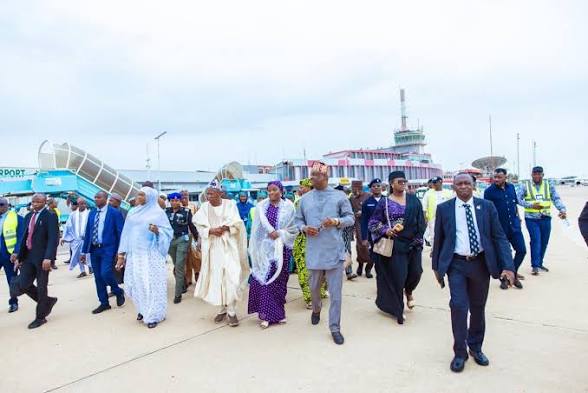
The Federal Government has inaugurated the newly remodeled Muhammadu Abdulkadir Dankabo Domestic Terminal at the Malam Aminu Kano International Airport, describing the project as a major step in repositioning aviation infrastructure in Northern Nigeria.
The inauguration was performed by the Minister of Aviation and Aerospace Development, Festus Keyamo, alongside the Managing Director of the Federal Airports Authority of Nigeria (FAAN), Mrs Olubunmi Kuku, and Chairman of the FAAN Board, Dr. Abdullahi Ganduje, with other dignitaries in attendance.
Government officials said the upgraded facility is designed to enhance passenger experience, ease movement of goods, create jobs, and attract private investment into the region’s aviation and logistics ecosystem.
Keyamo announced a major funding commitment for Kano Airport, noting that President Bola Tinubu has approved N46 billion for the rehabilitation of both runways and taxiways.
“The president has approved the sum of 46 billion naira for only Kano Airport, for the resurfacing of the two runways here, the secondary and primary runway and the taxiways. This money is not audio money. 60% of this money has been released already, and the contractors are on site,” Keyamo said.
He stressed the strategic importance of Kano to Nigeria’s aviation map.“This is the commercial heartbeat of northern Nigeria, and that is why you hear when the Managing Director FAAN said that this is about the fourth busiest airport in Nigeria. That is why we have to match Kano for major upgrade,” the Minister added.
Chairman of the FAAN Board, Dr. Abdullahi Ganduje, said the terminal goes beyond bricks and mortar. “This project represents much more than the rehabilitation of physical structure. It symbolizes progress, renewed commitment, and our collective determination to build an aviation sector that meets the expectations of Nigerians and conforms to global standards of safety, efficiency, and passenger satisfaction,” Ganduje said.
He linked the upgrade to broader economic goals, noting that efficient airports are critical to growth.“Since the aviation sector remains one of the key drivers of national development, efficient airports will no doubt facilitate freight and traffic, investment, promote tourism, create employment, and strengthen national integration,” he stated.
FAAN Managing Director, Mrs Olubunmi Kuku, described the commissioning as a milestone under the Tinubu administration’s infrastructure agenda.“This day marks a significant milestone in our collective journey to reposition Nigeria’s aviation infrastructure in line with the Renewed Hope Agenda of His Excellency President Bola Ahmed Tinubu GCFR. The aviation sector has witnessed unprecedented transformation, and this terminal stands as a testament to his unwavering commitment to the development of critical national infrastructure,” Kuku said.
She said FAAN is committed to replicating world-class standards across all airports under its watch.
“The comprehensive remodeling and upgrade of the Dankabo domestic terminal represents our determination to deliver world-class airports to the Nigerian people and across every state where the Federal Airports Authority of Nigeria has presence. With these upgrades, I expect this airport to even do better and compete with both Abuja and Lagos,” Kuku added.
Aviation stakeholders at the event noted that Kano, as a major hub for commerce, agriculture and religious travel, has long required infrastructure that matches passenger traffic. The terminal renovation includes improved check-in areas, passenger flow management, modern conveniences, and better security screening.
With the runway project now underway and 60% of the N46 billion already released, officials say the airport is set to handle larger aircraft, reduce turnaround times, and improve safety.
The Federal Government said similar upgrades will continue across other regional airports as part of efforts to decentralize air travel, boost non-oil exports, and position Nigeria as a regional aviation hub.
For Kano business community, the new terminal and runway works are expected to cut logistics costs, improve cargo movement, and support the city’s status as a trade gateway to West and North Africa.