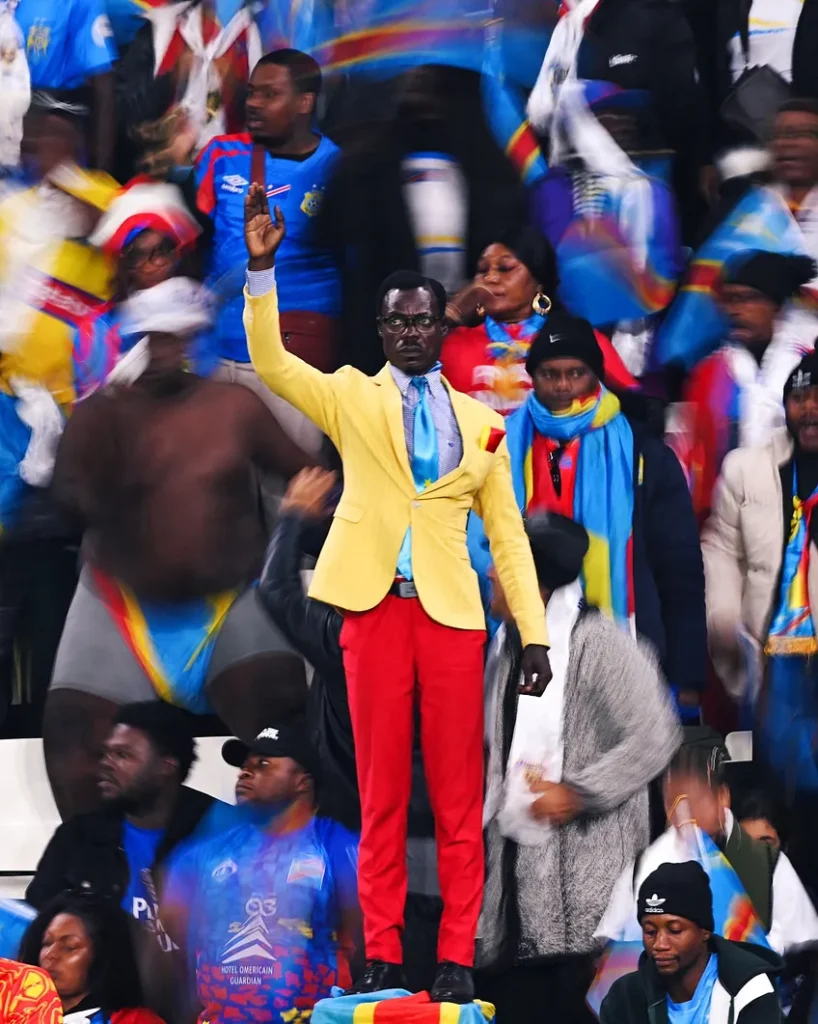
the iconic Patrice Lumumba statue who lit the AFCON 2025
It was the last minute of the match. Ramiz Zerrouki saw his chance. He immediately slipped the ball behind Aaron Wan-Bissaka, the former Manchester United man, for Adil Boulbina to run onto. The winger cut inside the exhausted full-back and blasted the ball past the hapless Congolese goalkeeper.
Algeria 1 – 0 Congo.
The statue wept.
The joyous delirium of tens of thousands of Algerians could be heard all over Rabat. But within the stadium, amidst the stunned silence of the Congolese supporters, the right hand of Patrice Lumumba slowly began to drop. He had stood for 120 minutes. His eyes defiant, his pose unflinching.
The Leopards of Congo had played four matches in Morocco, and each time they took to the pitch, Patrice Lumumba stood over the pitch like a bronze specter, decked in a colorful suit. Seeing him each time sent something like a chill down my spine.
There was something surreal about seeing Lumumba standing completely still while all around him the bright blues, yellows, and red of the Congolese supporters jumped, danced, and sang. It felt almost like as he stood there, Congo played with 12 men. That no matter what happened, everything would be alright.
Football, however, runs on its own rules. And when the referee’s final whistle condemned Congo to defeat, the spell broke. As Lumumba’s right hand fell, tears fell down his eyes too. He took off his spectacles and began to wipe the tears. The statue of Patrice Lumumba had given way to Michel Kuka Mboladinga. It moved me.
“I stay still to give strength to the team, to pass energy on to the players,” Arguably the defining image of the ongoing African Cup of Nations, Mboladinga, also known as “Lumumba Vea” for his resemblance to Congo’s first Prime Minister, has forced an entire continent, and many around the world, to remember what Patrice Lumumba means, not only to Congo, but to Africa. I’ve seen so many football fans on social media platforms, from South Africa to Nigeria, pledging their support to Congo just because of this towering symbol.
It has also been pointed out that Mboladinga is an adherent of La Sape, a movement which embodies the style and manners of European dandies from the colonial era. In Congo, Sapeurs (male) dressed in colorful suits and trousers, a trend that continues till today.
Furthermore, a lot of Africans following the tournament understand the symbolism of Mboladinga’s gesture. Some are okay to just understand that, “he is symbolizing Lumumba. That Congo president who died years ago.” and that’s okay. Personally, something deeper touched me.
I belong to that generation of Africans raised on essential African history. Taught about modern African activists, heroes, and martyrs. Kwame Nkrumah, Nnamdi Azikiwe, Patrice Lumumba. So quite naturally, seeing Mboladinga’s gesture made me see beyond just a man standing still in a stadium to test his endurance levels, or to look like Patrice Lumumba.
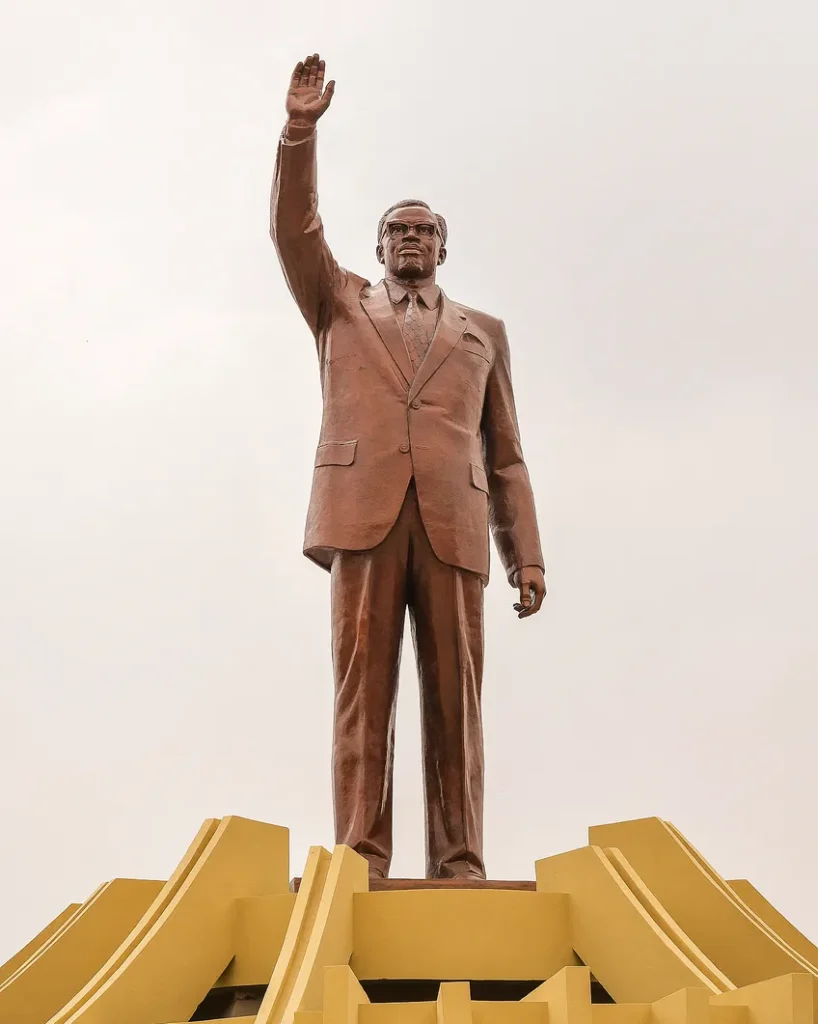
CONGOLESE INDEPENDENCE PRIME MINISTER
For many Congolese, and Africans around the continent, Lumumba is not just a historical figure. He is a wound that has never healed. A promise that was dissolved before it could be fulfilled. Since Lumumba’s death in September 1961, the Congo of his dreams has not known a single day of peace.
After Congo’s independence, and in order to infinitely exploit Congo’s mineral resources, Belgium, aided by the United States of America, orchestrated the removal and assassination of Lumumba by recruiting another Congolese called Joseph Mobutu “Mobutu Sese Seko” to assassinate him.
In September 1960, Joseph Mobutu was ordered to deal with Lumumba. He staged a coup, and backed by Belgian and US personnel, his forces captured Patrice Lumumba. The details of his death are well known. He was Prime Minister of Congo for ten weeks.
Today, what is Congo known for? More or less as one of the wealthiest countries in terms of immense natural resources, and simultaneously as one of the poorest and most war-torn regions in the world. This poverty is a result of the decades-long exploitation of Congo’s human and natural resources. An exploitation that Lumumba foresaw, and gave his life fighting against.
So what does Lumumba’s life and death have to do with the African Cup of Nations? Maybe the question should be, what doesn’t it have to do with it? The connections are apparent.
For one, football, like many other sports, fosters and promotes peace and unity. Especially among different peoples. Jered Bitobo, head of communication for the Congolese supporters group, described Mboladinga’s pose as a “a sign of peace”, saying,“He is sending out a strong message, both at local and international level. The open palm is a sign of peace and we need peace in our country.”
Congo is currently caught in a brutal conflict in its eastern provinces along the border with Rwanda. The M23 armed group, backed by Rwanda, has displaced millions. Villages have been burned. Women have been assaulted. Children have been conscripted. The minerals that should make Congo rich are being smuggled all over the place to fund the violence. Peace is long overdue in that country, and in the continent at large. It’s an important reminder.
Secondly, the African experience is shared. From North to South Africa, the story of Africa has been one of fighting for freedom and self-governance against foreign aggression. This is why Lumumba was also very vocal in his support for the Algerian War of Independence. The Algerians never forgot. They immortalized him for it.
In the wake of Algeria’s victory over Congo, an Algerian player stood in front of Mboladinga, mimicking his pose and mocking him. On social media, some Algerians found it amusing. But these are outliers. Most Algerians know and respect Lumumba. Theirs is a country of revolutionaries and political struggle.
As it turns out, the struggle still continues. Many African countries, from East to West, North to South, still contend with being looked down on, and considered racially and culturally inferior by foreigners. Lumumba’s vision of a Congo and Africa united, prosperous, and free, has never felt more distant. His ghost still looms large over the region.
Looming large over stadiums in Morocco, the legacy of Patrice Lumumba has re-entered conversations across the globe. Mboladinga’s performance has gone viral. Cameras have captured him. Social media has spread his image. Algerian citizens, in showing their admiration for him, and understanding of the historical context, were quick to point out that a prominent street in Algeria is named after Patrice Lumumba. Mboladinga has become, in the words of one journalist, “the tournament’s most remarkable supporter.”
How often do we get to learn about our history while watching a game of football or tennis or golf? How often does the gesture of one man in a stadium of tens of thousands become a catalyst for people to learn about important historical figures and events?
It’s amazing really. A lot of people who have shared “#FreeCongo” posts on social media have gotten a better understanding of this need to introduce peace to Congo, and to many other African countries impacted by imperialism and state-sponsored violence. Many others are just learning about Patrice Lumumba for the first time as well.
I’m thinking and sharing my thoughts on this because I don’t think I’ve witnessed such a profound display of symbolism in all my years of watching football. Very relevant symbolism too.
On June 30, 1960, the day Congo gained independence, a ceremony was arranged. At the ceremony, King Baudouin of Belgium gave a speech. He praised his great-grandfather, King Leopold II, whose brutal exploitation of Congo, during which an estimated 10 million Congolese died, was one of the ugliest chapters in colonial history.Baudouin spoke of Belgium’s “civilizing mission” and the “genius” of Leopold II.
After his speech, Patrice Lumumba stood up. His speech was not on the program. It was not approved. But he spoke anyway.
“We have known ironies, insults, blows that we endured morning, noon, and evening, because we are Negroes. We have known that the law was never the same whether dealing with a white or a Negro… We have known that there were magnificent houses for the whites and crumbling shanties for the blacks.”
Lumumba did not thank Belgium. He did not praise Leopold. He reminded the world, and the Belgians sitting in that room, of what colonialism had actually been: theft, assault, death, and exploitation.
“We shall show the world what the Black man can do when working in liberty,” he declared. “And we shall make the Congo the pride of Africa.”
The African Cup of Nations has long been looked down on as an inferior FIFA tournament. Whenever the tournament comes around, football clubs around Europe outrightly refuse to release African players, or release them reluctantly and with conditions handed out to the countries they’re representing.
The current tournament is barely in its quarter-final stages and has already been lauded internationally for its quality, not just on the pitch, but for its infrastructure and hospitality. Showing the world what Africans can do when working in liberty.Football, as they say, is just a game. But in Africa, it has never been just a game. It is identity. It is pride. It is history. It is AFCON-ball.
The Leopards of Congo have exited. Mboladinga is on his way home. The cameras will stop following him. The social media posts will fade. But the image will remain: the symbol of Patrice Lumumba, standing in the terraces, arms raised as though saying: “This is Africa.”
Credit: originally published here by Malick Noir