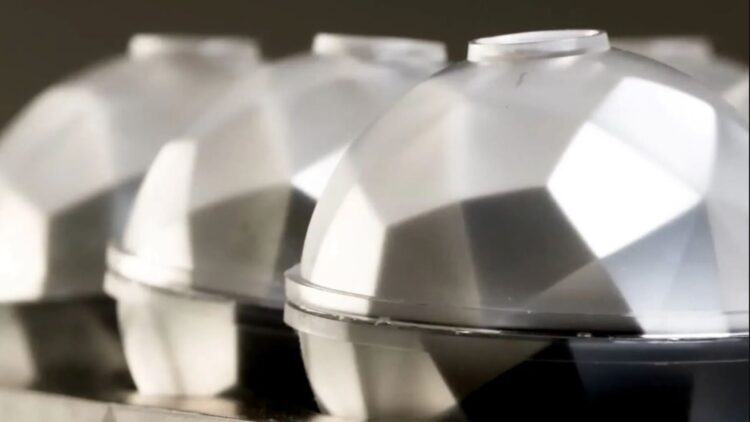
For more than a century, solar panels have always been flat; however, Japan has achieved the impossible yet again. In Japan, research is deemed so important that JAMIC (Japan Microgravity Center) was formed. The Center was a former mine shaft converted into a research site with a 710-meter tunnel holding a drop facility for microgravity experiments.
Although the early days of photovoltaics from the 1880s prescribed solar panels that needed to be designed based on the materials sourced for the panels, Japan is opting to be guided by the direction of the sun.
Kyosemi’s Sphelar® reaches a milestone by asking the question of why solar panels have to be flat and then proving that solar panels do not have to be flat.
When lab tests were conducted, it was found that sunlight comes from all directions and strikes from almost everywhere.
This is when Mr. Nakata of Kyosemi’s Sphelar® realized that a solar panel of a spherical shape could harness the sun’s energy better than a flat panel.
While early adopters of the panel were initially skeptical of this new design, they slowly embraced the idea of a spherical solar panel.
To date, this company captures the story of a complete change in the solar vision.
In this way, Japan became the first country to explore the concept of a spherical solar panel. Japan’s first-ever photovoltaic sphere has been unveiled, which provides us with an entirely new way to think of renewable energy.